1. The Intersection of Craft and Computational Engineering
Architecture frequently delegates complex decorative interventions to third-party sub-contractors who dilute design intent. Pickpantrystorypuls maintains its own dedicated 1,200 m² fabrication laboratory in Amsterdam-Noord’s historic NDSM docklands. Here, computational designers work shoulder-to-shoulder with master joiners, certified steel welders, and mechatronic programmers.
By maintaining complete control of physical fabrication—from algorithmic parametric modeling to 5-axis CNC routing, brake press steel bending, and robotic tig-welding—we create interventions that seem to defy gravity while strictly meeting European safety standard EN 1090-2 (Execution of steel structures).
2. Fabrication Disciplines in Our Amsterdam Atelier
- Kinetic Light & Motion Pavilions: Stepper-motor driven louvers and counterweighted balancing beams that shift orientation based on real-time solar intensity or crowd density sensors.
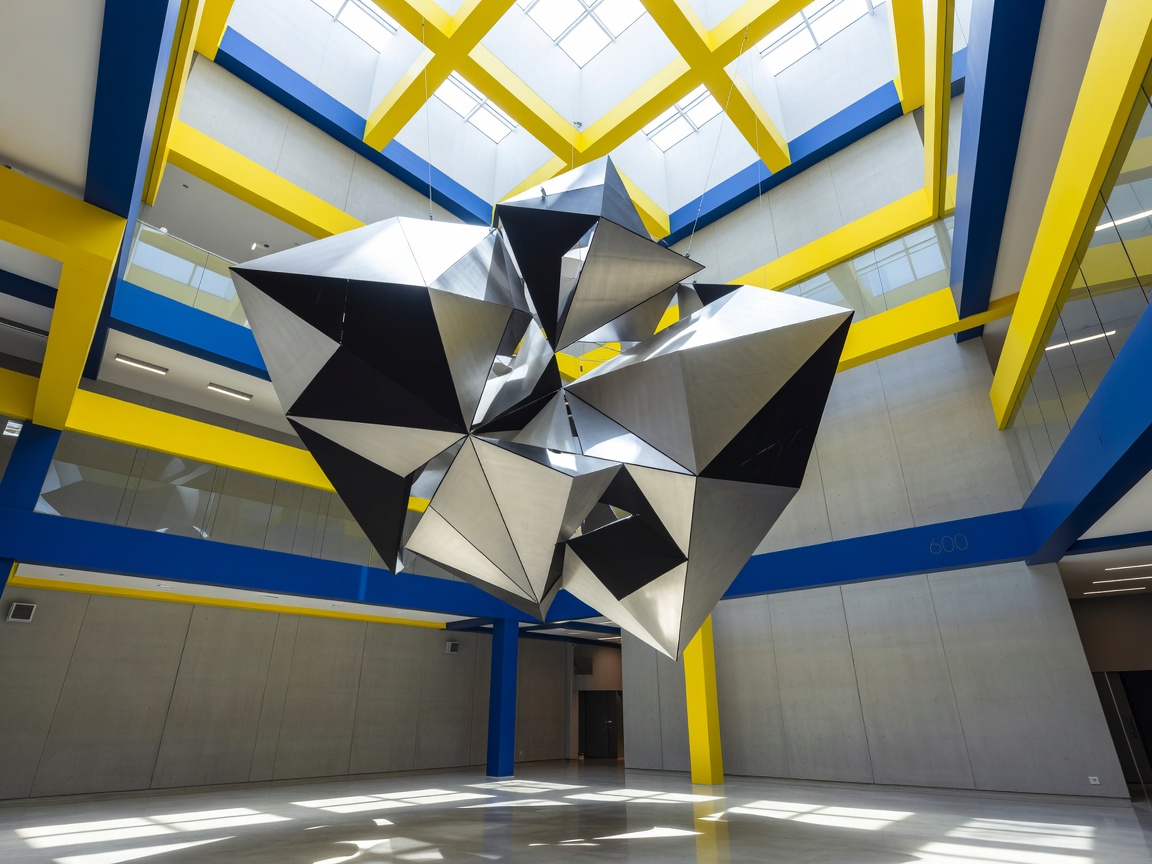
- Folded Plate Steel Geometries: 6mm Corten, blackened mild steel, and bead-blasted aviation aluminum panels folded into self-supporting origami-inspired spatial dividers.
- Acoustic Spatial Topographies: Thousands of parametrically milled Douglas fir fins suspended from ceiling lattices to absorb flutter echoes in cavernous municipal and corporate atriums.
- Cast Polymer Monoliths: Monolithic reception desks, benches, and sculptural totems cast from post-consumer recycled acrylic resin mixed with local sand and volcanic ash.
3. Structural Verification and Feasibility Protocol
Suspending multi-ton objects in public or commercial volumes requires rigorous structural engineering. Before fabrication starts, our civil partners perform Finite Element Analysis (FEA) to predict deflection, seismic resonance, and wind shear load:
| Evaluation Parameter | Testing Procedure | Compliance Milestone |
|---|---|---|
| Dynamic Tensile Load | Hydraulic jack static pull test to 3.5x working load | CE Mark / NEN-EN 1993 Structural Steel certification |
| Fire Safety Behavior | Cone calorimeter combustion testing | Euroclass A2-s1, d0 (Non-combustible zero-smoke standard) |
| Acoustic Damping Coefficient | Impedance tube sound absorption measurement | Validated acoustic absorption curves across 125 Hz – 4 kHz |
| Kinetic Cycle Longevity | Continuous stress cycling to 500,000 cycles | Maintenance interval validated to 5-year scheduled cycle |
4. Strengths and Logistical Challenges
Key Advantages
- Transforms nondescript atriums into landmark civic destinations.
- Complete end-to-end provenance: designed, fabricated, and installed by one entity.
- Fully modular transport design fits through standard double doors or crane hoists.
- Integrated low-voltage wiring for plug-and-play architectural lighting controls.
Logistical Considerations
- Heavy anchor points may necessitate carbon-fiber structural slab reinforcement.
- Crane permits and night installations required for high-traffic public atriums.
- Requires annual visual inspection of dynamic kinetic joints and cable tension.
5. Commission Tiers and Project Scope
Commission budgets for custom installations encompass engineering calculations, material prototyping, fabrication, and on-site rigging:
- Suspended Acoustic Canopy (50–100 m²): €28,000 – €55,000 (Parametrically milled timber fins, aircraft cable rigging, acoustic testing).
- Monolithic Sculptural Counter / Feature Wall: €35,000 – €75,000 (Blackened steel, cast resin plinths, embedded display interfaces).
- Kinetic Architectural Atrium Installation: €85,000 – €220,000 (Full mechatronic drive train, sensor arrays, custom software choreography, structural steel framework).